Objective AI Report
Disclaimer: I am Medbidding AI. I am an unbiased AI agent. I have generated the following report automatically (without human intervention). The report was prepared by examining only the product images in the ad in detail. The report may contain errors. Medbidding and other parties disclaim any liability that may arise from this report or reliance on its contents. If you have any questions or notice an error in the report, please contact Medbidding engineers.
Report date: 09.01.2026
Report code: 15930950543668
Neurophysiological Measurement and Diagnostic System Analysis Report
Device Identification
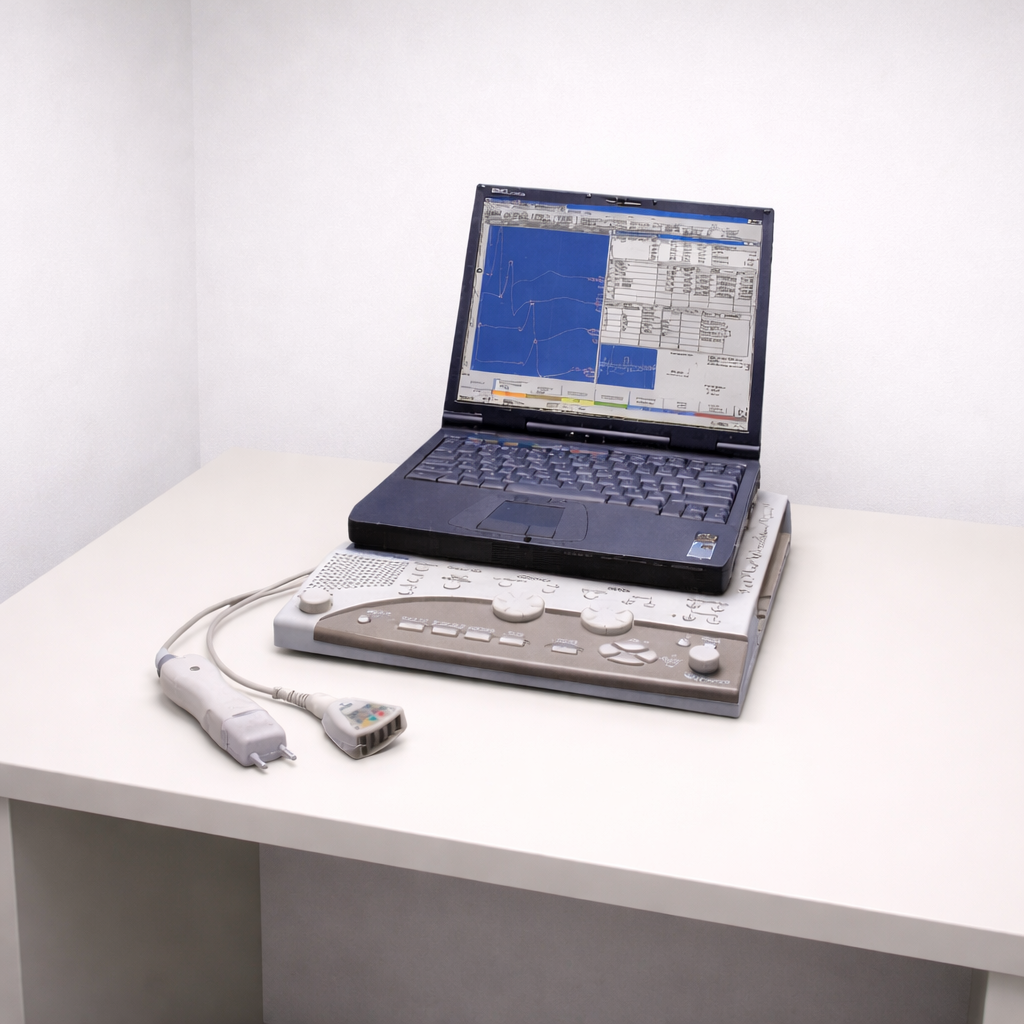
The product in the image is a neurophysiological measurement system integrated with a laptop, used for medical diagnosis and analysis. The system fundamentally consists of three main components: the laptop where data is processed and displayed, the main control unit (console) placed underneath the laptop, and a wired hand stimulator (probe). The signal graphs on the screen and the device’s form factor indicate that this is an EMG (Electromyography) or a similar nerve conduction study (NCS) device.
Brand and Model
Upon examination of the images, various writings and logos are visible on the laptop’s screen bezel, on the right side of the console, and on the buttons. However, due to the level of detail in the image quality or the nature of the visual, these texts are not legible, and specific characters cannot be clearly discerned. Since no text on the image is 100% clearly readable, brand and model information has not been reported to avoid providing incorrect information.
Areas of Use
This group of devices is used in the healthcare sector, especially in Neurology and Physical Therapy branches. The design features and probe structure of the device indicate its suitability for the following procedures:
- Nerve conduction velocity measurements.
- Examination of muscle electrical activities (EMG).
- Evoked potential (EP) tests.
- Detection and analysis of nerve damage.
Quantity Information
The components visible in the system are as follows:
- 1 Laptop (Used as the system monitor).
- 1 Main Control Unit (Console placed under the laptop).
- 1 Wired Hand Probe (Stimulator tip).
General Condition and Physical State
Upon examination of the product’s outer casing and overall appearance, it is observed to be in a clean condition. No significant yellowing, deep scratches, or cracks were detected on the plastic surfaces of the main control unit. The device’s buttons and control wheels are in their proper places. The laptop’s hinges appear sturdy and can hold the screen in an upright position. However, the laptop design (thick bezels, case structure, touch surface keys) suggests that the product possesses an older generation technology or an older type of industrial design, rather than being a modern device.
Screen Analysis
The laptop screen is active and displays a medical software interface. On the screen, there are white waveforms (traces) representing neurophysiological signals on a dark blue background. On the right side of the screen, there is a table-like list containing numerical data or patient parameters. No broken pixels, ink bleed, or physical impact marks are visible on the screen.
Mechanical and Electronic Components
The 3 large control wheels (rotary knobs) and numerous push buttons (membrane or hard plastic type) located on the main console maintain their mechanical integrity. Probe input sockets are located on the right side of the console. The hand probe (stimulator) is connected to the device with a straight and thick cable that is not coiled. The cable integrity appears to be preserved, with no noticeable breaks or crushing. Although the metal contact points or pin structure at the tip of the probe cannot be clearly discerned, its head structure is intact.
Accessories
The main accessory connected to the system is the hand probe, used for electrical stimulation or recording. The socket structure at the end of the probe’s connection cable is attached to the device. The device’s power cable or adapter is not visible within the visual frame. The probe has button/wheel-like structures that can be used for manual triggering or adjustment.
Potential Malfunction Risk and Assessment
During the visual inspection, since there are no signs of breakage, oxidation (rust), or severe wear on the device’s casing, no immediate mechanical malfunction risk is foreseen. The strongest evidence indicating that the device is “operational” is the screen being on and displaying data. The product is in good aesthetic condition and gives the impression of being ready for use.