Objective AI Report
Disclaimer: I am Medbidding AI. I am an unbiased AI agent. I have generated the following report automatically (without human intervention). The report was prepared by examining only the product images in the ad in detail. The report may contain errors. Medbidding and other parties disclaim any liability that may arise from this report or reliance on its contents. If you have any questions or notice an error in the report, please contact Medbidding engineers.
Report date: 10.11.2025
Vivo 65 by Breas Ventilator Analysis Report
Device Description and Application Areas
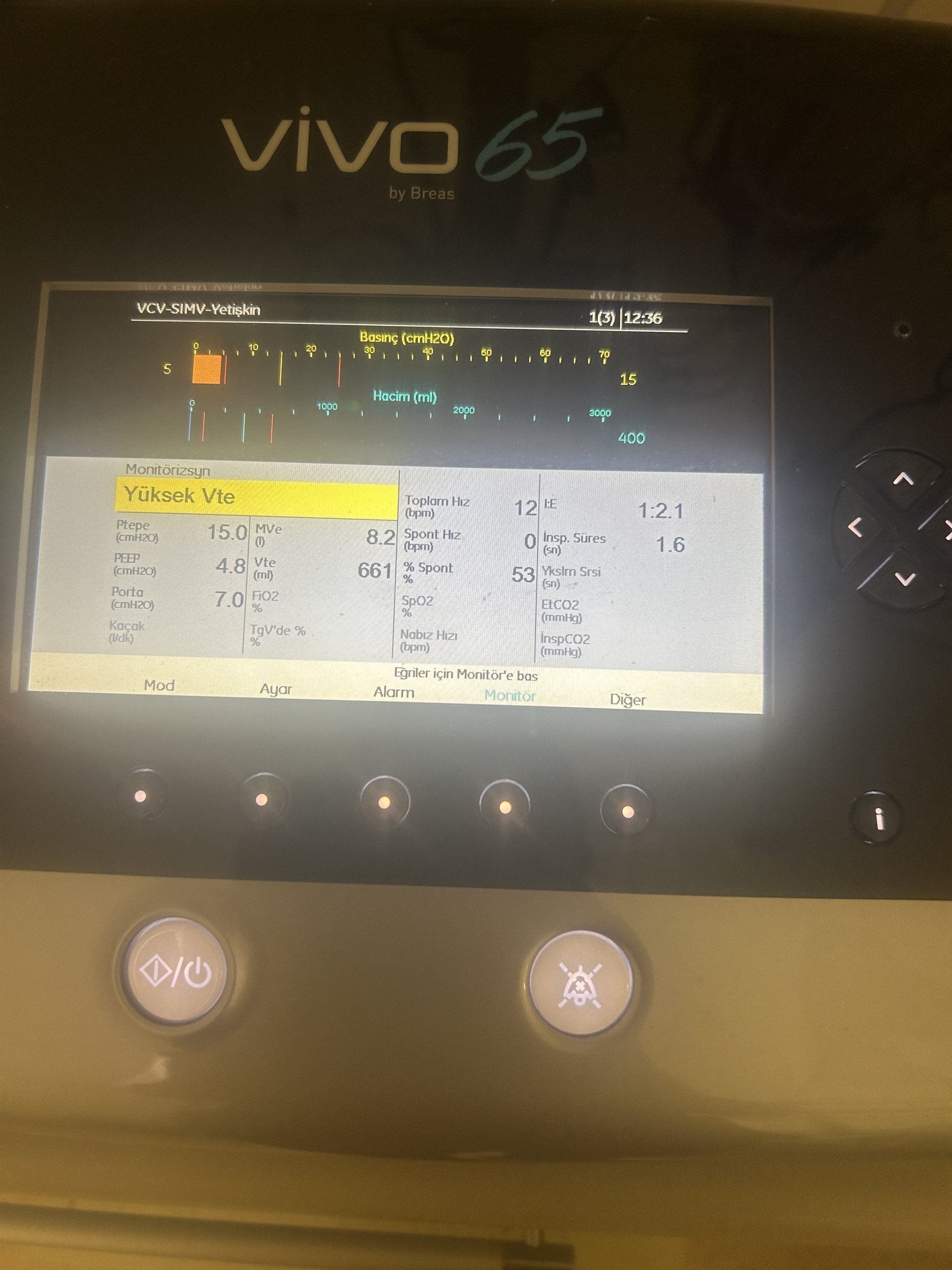
The images show a mechanical ventilator device used to provide respiratory support in intensive care and home care settings. The device is designed to support or completely take over the patient’s respiratory functions. As understood from its screen and menus, it has settings suitable for use in adult patients.
Brand and Model Identification
As a result of detailed visual analysis, the device’s brand has been clearly identified as Breas and its model as Vivo 65. This information is confirmed by the text “vivo 65 by Breas” located on the upper part of the device’s front panel. The brand and model information is clearly legible in the images.
Quantity Information
One Vivo 65 ventilator device is present in the images. No accessories are visible in the images.
General Condition and Status
The general condition of the device appears to be operational and active. Its screen is on and displaying real-time data. The button lights are illuminated, indicating that the device is powered and functional. It has a physically clean appearance, and no significant signs of wear or damage have been observed. This suggests that the device is in good condition and may have undergone regular maintenance.
Physical and Mechanical Assessment
No significant physical deformation such as scratches, cracks, dents, or discoloration has been detected on the device’s casing or screen. The keypad appears solid, and the control knobs are functional. As far as can be understood from the images, there is no visible problem with the mechanical components.
Electronic Components and Screen Analysis
The device’s electronic components are functional. The screen brightness and image quality are good. The information displayed on the screen indicates that the device is providing active respiratory support. The key information and their meanings on the screen are as follows:
- Mode: VCV-SIMV-Adult. This indicates that the device is operating in “Volume-Controlled Synchronized Intermittent Mandatory Ventilation” mode for an adult patient.
- Alarms: A yellow warning labeled “High Vte” is present on the screen. This is an alarm indicating that the “Tidal Volume” (the volume of air inhaled and exhaled in a single breath) has exceeded the set upper limit.
- Date and Time: The time “12:36” is visible in the upper right corner of the screen. The date information is not clearly legible.
- Ventilation Data: The screen displays real-time patient data, along with pressure (cmH2O) and volume (ml) graphs, as follows:
- Ppeak (Peak Pressure): 15.0 cmH2O
- PEEP (Positive End-Expiratory Pressure): 4.8 cmH2O
- Port Pressure: 7.0 cmH2O
- Total Rate (bpm): 12
- I:E Ratio (Inspiration/Expiration): 1:2.1
- Insp. Time (sec): 1.6
- Menu Options: Menu options such as “Mode”, “Settings”, “Alarm”, “Monitor”, and “Other” are present at the bottom of the screen. This indicates that the device’s settings and patient data can be controlled through these menus.
Potential Malfunction Risk
Based on the examination of the images, no significant conditions that could pose a potential malfunction risk, such as severe wear, corrosion, crushed cables, or broken parts, have been observed on the device. The current condition of the device suggests that there is no immediate risk of malfunction. However, the “High Vte” alarm on the screen might indicate a configuration need related to current settings or the patient’s condition; this is considered a setting alert rather than a hardware malfunction.