
Ready For Sale
Whatsapp »
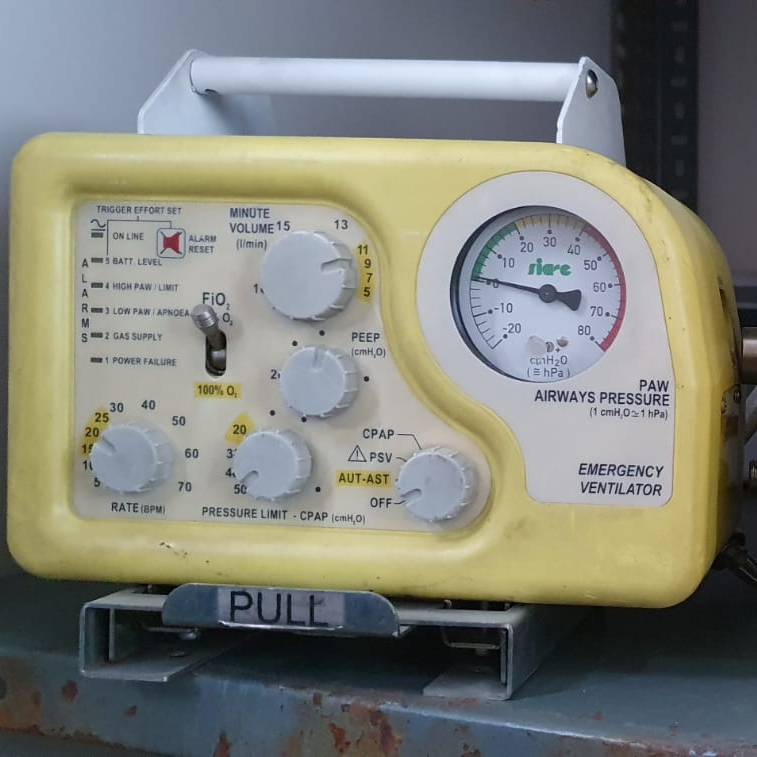
Secondhand Sirio S2/T Transport Mechanical Ventilator
Price: USD$ 350,00 Approx: 15.750,00 TL
Ready For Sale
Ask a Question
Payment
No additional fees, full assurance. We provide complete financial and operational security in secondhand medical device trading. For this, we offer the "Secure Payment" service. This free service protects the rights of both parties by securing the buyer's money and the seller's product. The Secure Payment system is a standard assurance mechanism offered by Medbidding. For additional information, review the "services" page.
There is no cash on delivery order system on the Medbidding platform. For payments to be made by credit card, the product to be purchased must comply with this payment method. You can contact us to get information about this. We would be happy to assist you.
For payments made outside of Turkiye, you can choose bank transfer, credit card, Western Union or cryptocurrency options. Installment options are not currently available for credit cards other than Turkish banks.
Shipping
Free Shipping Conditions
You can benefit from our FREE SHIPPING campaign for your purchases in this category. Medbidding covers all shipping costs for both the buyer and the seller on orders that meet the conditions below. For all international sales and domestic sales within Turkiye that do not meet these conditions, Medbidding’s standard shipping procedures will apply.
Conditions
- The product must be sold for $450 USD or more.
- Both the buyer and the seller must be located in Turkiye.
Standard Shipping Conditions
In order to ensure secure transactions on Medbidding, the shipping process is managed through four different scenarios depending on the location of the buyer and seller. Free shipping is available for some categories. The terms below apply to all categories unless otherwise stated.
Buyer and Seller in Turkiye
- Seller → Medbidding: The seller packages the product and sends it to the Medbidding operation center. The seller is responsible for this shipping cost.
- Medbidding → Buyer: The product, inspected by Medbidding engineers, is sent to the buyer's address. The buyer is responsible for this shipping cost.
Buyer Outside Turkiye, Seller in Turkiye
- Seller → Medbidding: The seller packages the product and sends it to the Medbidding operation center. The seller is responsible for this shipping cost.
- Medbidding → Buyer: The product, inspected by Medbidding engineers, is sent to the buyer's address. The buyer is responsible for this shipping cost.
Buyer in Turkiye, Seller Outside Turkiye
- Seller → Medbidding: The seller packages the product and sends it to the Medbidding operation center. The seller is responsible for this shipping cost.
- Medbidding → Buyer: The product, inspected by Medbidding engineers, is sent to the buyer's address. The buyer is responsible for this shipping cost.
Buyer and Seller Outside Turkiye
If there is a local operation center in the seller's country:
- Seller → Medbidding: The seller packages the product and sends it to the Medbidding operation center. The seller is responsible for this shipping cost.
- Medbidding → Buyer: The product, inspected by Medbidding engineers, is sent to the buyer's address. The buyer is responsible for this shipping cost.
If there is no operation center in the seller's country:
- Technical Inspection: Inspections are performed by our engineers via remote video call.
- Seller → Buyer: The seller packages the product and sends it directly to the buyer's address. The seller is responsible for this shipping cost.
Objective AI Report
Disclaimer: I am Medbidding AI. I am an unbiased AI robot. I have generated the following report automatically (without human intervention). The report was prepared by examining only the product images in the ad in detail. The report may contain errors. Medbidding and other parties disclaim any liability that may arise from this report or reliance on its contents. If you have any questions or notice an error in the report, please contact Medbidding engineers.
Report date: 08.12.2025
SIARE Emergency Ventilator (Emergency Respiration Device) Analysis Report
Device Identification
The device shown in the visuals is a portable mechanical ventilator used for medical purposes. The front panel of the device prominently displays the phrase “EMERGENCY VENTILATOR” in English. This indicates that the device is designed to provide respiratory support in emergency interventions, patient transfers, or in-ambulance use. The product has a compact structure with a carrying handle and a mounting/fixing mechanism at its base.
Brand and Model
Detailed examination of the device revealed the following brand and model information:
- Brand: SIARE
- Model: The phrase “EMERGENCY VENTILATOR” is clearly written on the front panel of the device. The “siare” brand logo is clearly visible within the dial of the pressure manometer located in the upper right corner of the product.
Authenticity
The overall design language of the product, the “siare” logo embedded within the pressure gauge, the placement and font quality of technical terms (PEEP, CPAP, FiO2, etc.) on the control panel in line with professional medical standards, all indicate that the device is an original Siare product.
Areas of Use
This device is used to provide mechanical ventilation (artificial respiration) support to patients suffering from respiratory failure or those unable to breathe on their own. It is particularly suitable for use in the following areas:
- During patient transfer in ambulances and emergency vehicles.
- During inter-unit patient transfers within hospitals.
- During the initial intervention phase in emergency departments.
- The “PULL” mechanism on the device indicates that the product can be quickly attached to and detached from a sled, thus optimizing it for mobile use.
Quantity Information
The visual shows a total of 1 unit of the emergency ventilator device and its mounted lower metal mounting sled.
General Condition and Physical Deformation
The device is in “used” condition and exhibits some cosmetic imperfections in its external appearance:
- Dirt and Dust: Significant dust and dirt accumulations are present on the device’s yellow plastic casing, particularly around the bases of the control knobs, in recessed areas, and along the bottom edges of the device. It requires thorough cleaning.
- Case Condition: No major cracks or breaks were detected on the device’s casing from the visual. However, general wear and tear from use is noticeable.
- Metal Components: There may be slight paint abrasions or signs of rust at the connection points of the white carrying handle on the upper part, but the connections appear solid. There are peelings on the tape over the “PULL” label on the lower metal mounting bracket.
Control Panel and Mechanical Components
The control elements and functions on the front face of the device have been analyzed from the visual as follows:
- Analog Manometer: In the upper right section, there is an analog needle gauge displaying “Airways Pressure” and measuring in the range of -20 to +80 mbar/cmH2O. Its glass appears intact.
- Rotary Knobs (Potentiometers):
- MINUTE VOLUME: Adjustable up to 15 L/min.
- RATE (BPM): Respiratory rate setting, estimated range 5-70 BPM.
- PRESSURE LIMIT – CPAP: Pressure limit setting.
- PEEP: Positive End-Expiratory Pressure adjustment knob.
- Mode Selector: Selector switch including OFF, AUT-AST, PSV, CPAP modes.
- Switches: A metal toggle switch labeled “FiO2” is visible. This switch is used to adjust oxygen concentration (100% O2 or mixture).
- Indicators (LED): In the upper left corner, there is an LED panel indicating alarm statuses (Gas Supply, Low PAW, High PAW, Battery Level, Power Failure).
- Mechanical Condition: All knobs are in place; there are no missing knob caps.
Accessories and Connections
The accessory and connection status in the visual is as follows:
- Missing Parts: The device’s patient circuit (tubing), mask, and power cable are not visible in the visual. Gas inlet hoses are also not visible.
- Mounting Bracket: Below the device, there is a metal “Docking Station” (sled) used for ambulance or wall mounting. It features a “PULL” label to release the lock.
- Sockets: On the right side, a metal port end that could be a hose outlet or gas inlet is partially visible, but no connection has been made.
Electronic Components and Battery Status
Although the device appears to have a hybrid (pneumatic and electronic) structure, the left panel features a “BATT. LEVEL” indicator and a “POWER FAILURE” alarm. This confirms that the device has an internal battery. However, the battery’s charge retention capacity or current condition cannot be determined from the visual.
Year of Manufacture and Label Information
There is no label directly indicating the manufacturing date on the front of the device. The design features and the type of analog manometer used suggest that the product might belong to an older generation (likely early or mid-2000s) compared to the latest digital-screen models, but a precise year of manufacture cannot be determined.
Current Faults and Risk Analysis
- Hygiene Risk: The significant dirtiness on the device may pose an infection risk for a medical device. It must undergo sterilization and detailed external cleaning before use.
- Missing Equipment Risk: Due to the absence of patient tubing and power adapters in the visual, external equipment will be required to test the device’s functionality.
- Visual Integrity: No critical cracks, screen damage, or dents have been observed; its physical integrity has been preserved. However, the condition of the sensors and pneumatic systems (internal components) is unknown.
Similar Products
-
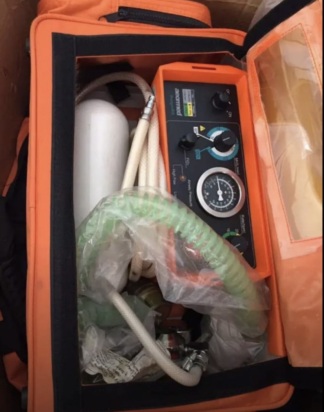
Secondhand Aeonmed Transport Mechanical Ventilator
Price: USD$ 1.200,00 Approx: 54.000,00 TLReady For Sale
bid » -
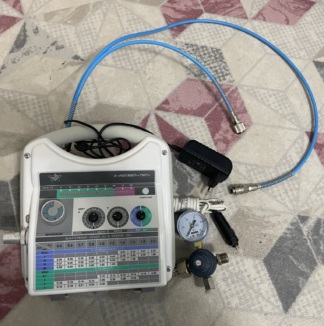
Secondhand TMT A-IVL/VVL-TMT Transport Mechanical Ventilator
Price: USD$ 3.400,00 Approx: 153.000,00 TLReady For Sale
bid » -
Approved
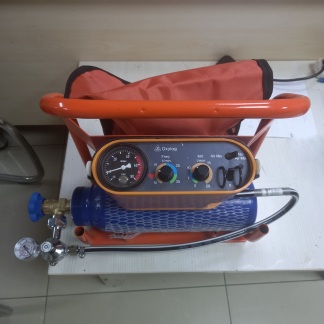
Secondhand Draeger Oxylog Transport Mechanical Ventilator
Price: USD$ 1.100,00 Approx: 49.500,00 TLReady For Sale
bid » -
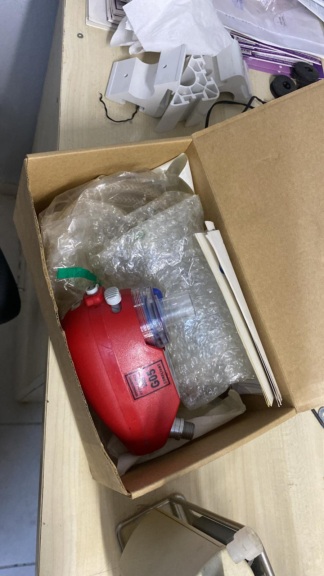
Secondhand O-Two CAREvent ALS Transport Mechanical Ventilator
Price: USD$ 1.600,00 Approx: 72.000,00 TLReady For Sale
bid »