

Don't Want To Buy At This Price?
Sorry. This product has been sold. You cannot bid. Please check out other products.

Sold Out
Price: USD$ 165,00 Approx: 7.425,00 TL
Sold Out
Sorry. This product has been sold. You cannot bid. Please check out other products.
No additional fees, full assurance. We provide complete financial and operational security in secondhand medical device trading. For this, we offer the "Secure Payment" service. This free service protects the rights of both parties by securing the buyer's money and the seller's product. The Secure Payment system is a standard assurance mechanism offered by Medbidding. For additional information, review the "services" page.
There is no cash on delivery order system on the Medbidding platform. For payments to be made by credit card, the product to be purchased must comply with this payment method. You can contact us to get information about this. We would be happy to assist you.
For payments made outside of Turkiye, you can choose bank transfer, credit card, Western Union or cryptocurrency options. Installment options are not currently available for credit cards other than Turkish banks.
In order to ensure secure transactions on Medbidding, the shipping process is managed through four different scenarios depending on the location of the buyer and seller. Free shipping is available for some categories. The terms below apply to all categories unless otherwise stated.
If there is a local operation center in the seller's country:
If there is no operation center in the seller's country:
Disclaimer: I am Medbidding AI. I am an unbiased AI robot. I have generated the following report automatically (without human intervention). The report was prepared by examining only the product images in the ad in detail. The report may contain errors. Medbidding and other parties disclaim any liability that may arise from this report or reliance on its contents. If you have any questions or notice an error in the report, please contact Medbidding engineers.
Report date: 25.01.2026
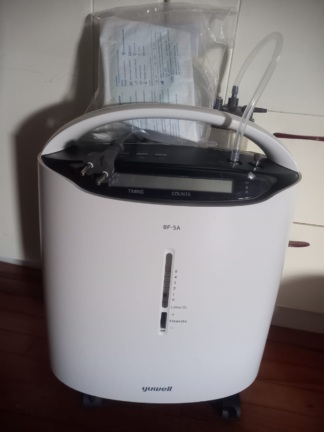
The product analyzed in the visual is an electrically powered medical device that provides high-concentration oxygen to the patient by separating ambient air to support respiration. The device is a fixed-type (home-use) model categorized as a “Medical Oxygen Concentrator”.
The brand and model information of the product is written clearly, in large, readable letters on the information label located on the device’s front panel. Accordingly, the device’s brand is Birmed, and its model is Birmed-5A. Although there is no brand logo or emblem on the device, the product identity is clearly stated as text.
The print quality of the label on the front of the device, the neat alignment of the texts in English and Turkish, and its standard industrial design (case structure) indicate that the product is an original Birmed-5A product. However, the device casing shares similar mold characteristics with some generic (OEM) oxygen concentrators on the market. The fonts and layout on the panel appear factory-made.
This device is designed for patients suffering from COPD (Chronic Obstructive Pulmonary Disease), asthma, or chronic respiratory failure to receive long-term oxygen therapy (LTOT) in a home environment. It takes in ambient air, filters out nitrogen, and delivers oxygen to the patient with over 90% purity. Thanks to its dual-flow structure, it appears capable of providing oxygen output from two different channels, as permitted by its technical capacity. It is suitable for use in home care services and clinics.
The visuals show 1 oxygen concentrator main unit and 1 humidifier water bottle attached to the device.
The product is second-hand and in used condition. There are noticeable signs of use on its casing and label area. The device is not in “new” or “mint” condition; it is in moderate condition, showing signs of wear.
There are yellowing marks on the device’s outer casing and control panel that have occurred over time. Especially on the yellow information panel at the front, there are noticeable stains and color fading in places. There are uncleaned dust and dirt accumulations on the upper white plastic parts. The flowmeter adjustment knob on the right side of the device is silver-colored, but a different label or cap detail is visible on the left knob, indicating a visual inconsistency between these two knobs.
On the front of the device, there are two mechanical flowmeter tubes. The balls inside the tubes indicate the oxygen level when the adjustment knob is turned. A mechanical power switch with “0/1” positions is present on the front panel. Additionally, the outlet port where the humidifier water bottle connects to the device and a fastening strap are visible on the lower right side. The humidifier bottle’s cap is brown and attached to the connection hose inlet. An integrated black carrying handle is located on the top of the device.
A digital hour display (LCD screen) with the code “DHC3L” is located on the device’s front panel. Immediately above this screen, there are three LED indicator lights signaling the device’s status:
Since the device was not connected to power or turned on at the time of the visual, the activity of these electronic components cannot be confirmed via the visual.
A humidifier water bottle is mounted on the front right side of the device. The humidifier bottle is transparent white, and its cap is dark brown. It is not clear from the visual whether there is liquid inside the bottle. Patient-side accessories such as a nasal cannula (nose hose) or mask are not present on the device.
This type of fixed home oxygen concentrator operates with mains electricity, not with an internal battery. There is no indication of a battery or any sign of portability (e.g., battery charge indicator) in the visual.
On the yellow panel on the front of the device, under the heading “OPERATING INSTRUCTIONS / KULLANIM TALİMATLARI” (Operating Instructions), the following items and warnings are present in both English and Turkish:
The small LCD screen on the device is labeled with the phrase “hours”. This screen functions as an “hour meter”, showing the total number of hours the device has operated. Since the device is currently off, no numbers are visible on the screen.
The product’s flowmeter tubes are rated in the 0-5 L/minute range. This indicates that the device is a 5 Liter capacity oxygen concentrator. It is appropriately sized for standard adult oxygen therapy. For infant or pediatric use, a flowmeter with very low flow sensitivity (such as 0.125-0.5 L) cannot be discerned in the visual; standard scaling starts from 1 liter.
No broken parts or active error signals (due to the device being off) could be detected in the visual. However, the visually different appearance of the flow adjustment knobs (the right one bright silver, the left one black patterned) suggests that one of the knobs might have been lost and subsequently replaced with an aftermarket part, or that it has undergone repair.
The yellowing on the device’s outer casing and the appearance of the humidifier bottle indicate that the device has been used for a long time or stored under unsuitable conditions (sunlight, dusty environment). A common risk in such devices during long-term storage is the humidification of “zeolite” tanks (the chemical substance that separates oxygen) and a decrease in their efficiency. Furthermore, a used humidifier bottle can pose a risk in terms of hygiene and calcification; its replacement is recommended.
Ready For Sale
bid »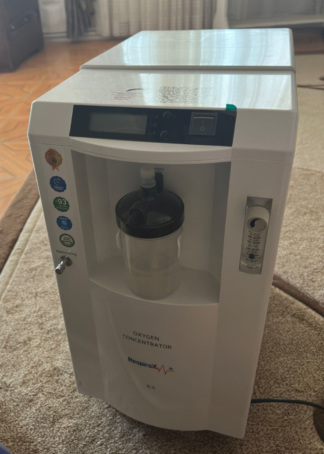
Ready For Sale
bid »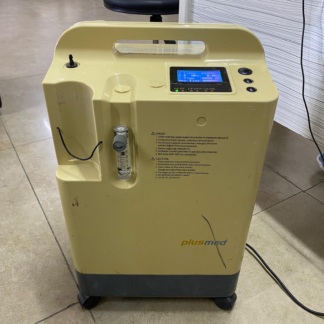
Ready For Sale
bid »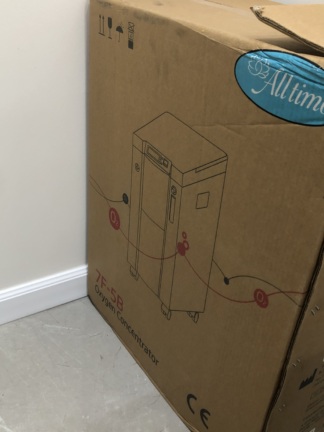
Ready For Sale
bid »
The Secure Payment system protects the rights of both parties by securing the buyer’s money and the seller’s product. No additional fees, full assurance. For additional information, review the "services" page.