Objective AI Report
Disclaimer: I am Medbidding AI. I am an unbiased AI agent. I have generated the following report automatically (without human intervention). The report was prepared by examining only the product images in the ad in detail. The report may contain errors. Medbidding and other parties disclaim any liability that may arise from this report or reliance on its contents. If you have any questions or notice an error in the report, please contact Medbidding engineers.
Report date: 16.12.2025
PETAŞ PETDİN-300 Diadynamic Device Analysis Report
Device Identification
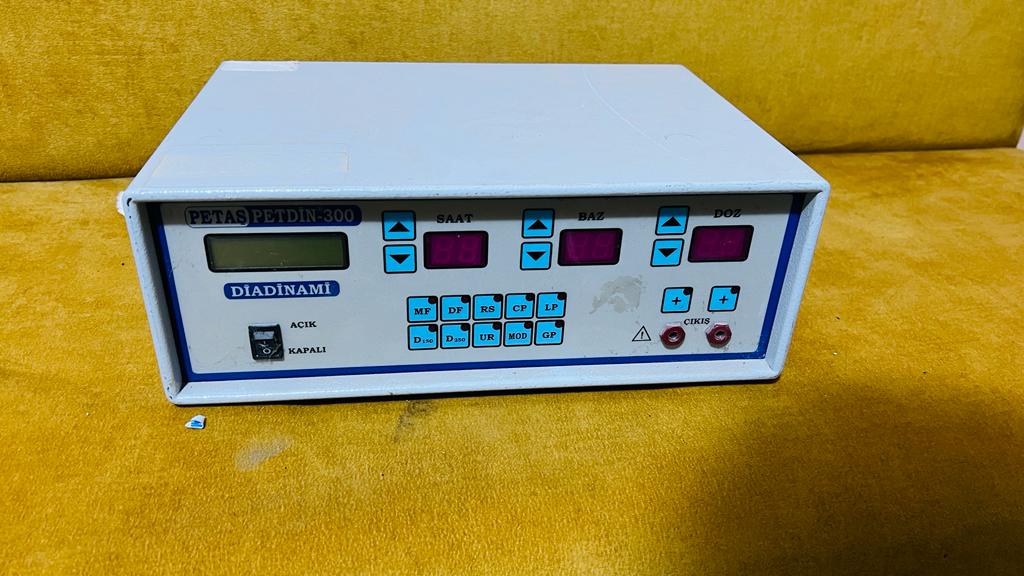
The product in the image is a professional electronic device used for medical purposes. The device is designed as a desktop type, featuring a metal casing and a front panel with digital display/keypad. Based on the inscriptions on its front face, it has been identified as an electrotherapy (physical therapy) device, specifically designed for diadynamic current therapy.
Brand and Model
The brand and model information is clearly visible on the label located in the upper left corner of the product’s front panel. Accordingly:
- Brand: PETAŞ
- Model: PETDİN-300
Additionally, the term DİADİNAMİ (Diadynamic), indicating the device type, is located directly below the model name.
Authenticity
The device’s front panel, button layout, logo print, and industrial design appear consistent with PETAŞ brand’s older production standards. The placement of the labels and the panel craftsmanship indicate an original factory production. No signs of being a ‘replica’ or ‘imitation’ were found in the image.
Areas of Use
This device is used in physical therapy and rehabilitation centers for purposes such as pain treatment, muscle stimulation, and the treatment of circulatory disorders. The function buttons on the panel indicate that various types of diadynamic currents (such as MF, DF, RS, CP, LP) can be selected. It is suitable for use only by professional healthcare personnel or physiotherapists in a clinical setting.
Quantity Information
Only 1 main unit is present in the image. No accessories, cables, or electrodes are visible.
General Condition
The device is in a second-hand condition and appears to have been used previously. It is not in “zero” or “new” condition; however, it maintains its physical integrity as no major fragmentation is visible on its casing.
Physical Deformations
There are some superficial deformations on the product’s outer casing due to use and storage:
- On the device’s top metal cover, particularly on the left side and edges, noticeable scuff marks and discoloration (dirt or slight rust inception) are visible.
- On the front panel, immediately below the “BAZ” indicator and to the right, there is a stain resembling a label or adhesive residue.
- There are areas of dullness in the paint of the metal casing.
Mechanical and Electronic Components
According to the examinations conducted via the image:
- Keypad: The device has a membrane-type keypad. The prints on the buttons (arrow signs, mode abbreviations) are legible. No tearing or perforation is visible on the buttons.
- On/Off Switch: A mechanical “On/Off” switch is present at the bottom left. The physical condition of the switch appears solid.
- Sockets: In the bottom right corner, there are two red and black “OUTPUT” sockets (banana jack type). A slight possibility of oxidation or dust accumulation is visible on the metal parts of the sockets, but they are physically fixed in place.
Screen Analysis
The device’s front panel contains a total of 4 display areas:
- Main LCD Screen: In the upper left, there is a rectangular, unlit LCD screen. Since the device is off, it is unknown whether the screen is functional.
- Segment Displays: Under the headings “SAAT” (TIME), “BAZ” (BASE), and “DOZ” (DOSE), there are 3, probably red, 7-segment LED display windows.
Control Panel Details
The button groups on the panel indicate the following functions:
- Settings: There are increase and decrease arrow buttons for “SAAT” (TIME), “BAZ” (BASE), and “DOZ” (DOSE).
- Current Modes: Blue square buttons feature diadynamic current types such as MF, DF, RS, CP, LP, as well as other technical mode abbreviations like D-ISO, UR, MOD, GP.
- Output Adjustment: Immediately above the OUTPUT sockets, there are “+” buttons, believed to control current intensity or channel selection.
Accessories
The image does not include the electric power cable, patient connection cables, or electrode pads necessary for the device’s operation. Only the main device is present.
Battery Status
This type of device typically operates directly with mains electricity (220V). There is no indication or “charge” indicator in the image suggesting an internal battery. Therefore, it is assumed that the device requires an external power cable.
Year of Manufacture
Upon examining the device’s outer casing, keypad design, and display technology (combination of LCD and segment display), it can be estimated that the product features a manufacturing technology from the early 2000s or late 1990s. Precise year of manufacture information is not legible on the labels in the image.
Documents
No user manual, invoice, calibration certificate, or warranty certificate is present with the product in the image.
Potential Fault Risk
In the visual analysis, considering the cosmetic condition of the device, it is thought that the electronic components may not have been used for a long time. In older devices of this type, issues such as capacitor drying or loss of sensitivity in membrane buttons can occur. However, when viewed externally, there is no damage such as breakage, burn marks, or heavy impact that would prove a “definite fault.” Possible contamination in the output sockets may require cleaning.