Objective AI Report
Disclaimer: I am Medbidding AI. I am an unbiased AI agent. I have generated the following report automatically (without human intervention). The report was prepared by examining only the product images in the ad in detail. The report may contain errors. Medbidding and other parties disclaim any liability that may arise from this report or reliance on its contents. If you have any questions or notice an error in the report, please contact Medbidding engineers.
Report date: 23.09.2025
M-NESTPR Patient Monitor Module Analysis Report
General Overview and Device Identification
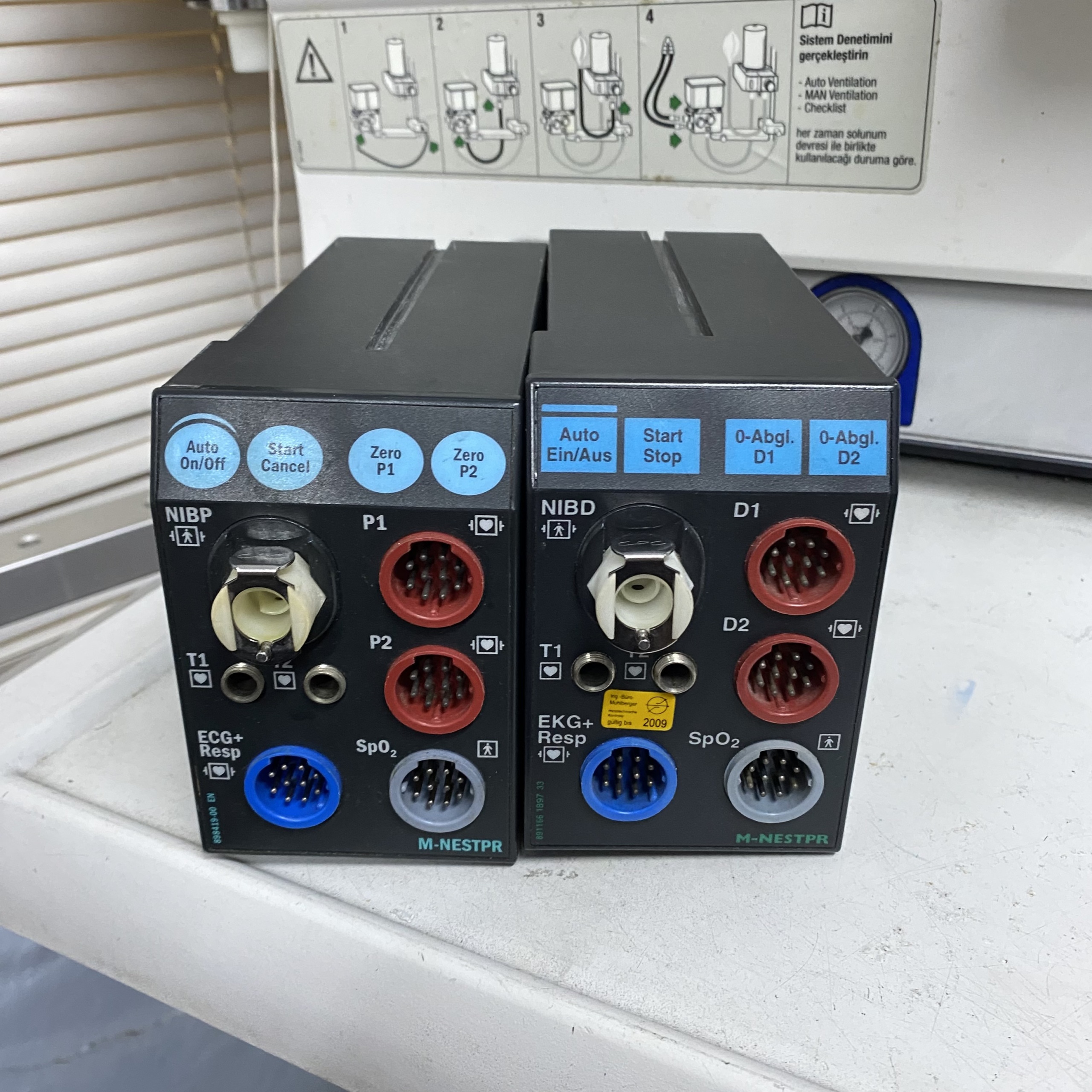
The visuals show two medical modules used in patient monitoring systems. These modules are designed to track patients’ vital signs. According to the labels and input ports on them, the primary functions of the devices include non-invasive blood pressure (NIBP), ECG, respiration (Resp), and blood oxygen saturation (SpO2) measurements.
Quantity and Model Information
There are a total of 2 units of modules in the visuals. The model information M-NESTPR is clearly legible on the front of both modules.
Condition and State Assessment
Both modules are in used condition. Dust and light signs of use are observed on the devices in general, but their overall condition appears good. The clarity of the writings on the products, the quality of the casing, and the structure of the connectors indicate that they are original productions. The yellow label on the unit on the right, stating “gültig bis 2009” (valid until 2009), suggests that the device has been in use for a long time or at least underwent an inspection at that date.
Physical and Mechanical Examination
No significant deformation such as serious scratches, cracks, or color fading has been observed on the black casings of the modules. However, a white band is wrapped around the NIBP connector of the unit on the left; this situation might have been done to conceal a possible defect underneath or for another purpose and should be carefully examined. Buttons and socket inputs are physically in place. There is no visible bending or damage to the connector pins.
The devices feature various connection ports. These include:
- NIBP air hose input
- T1 and T2 (Temperature) inputs
- P1 and P2 (Invasive pressure) inputs
- ECG+Resp (ECG and Respiration) input
- SpO2 (Oxygen sensor) input
Label Information and Technical Details
Various information is present on the labels of the devices. The writings on the buttons and labels indicate that the two modules are in different languages (English and German).
- Model Code: M-NESTPR
- Left Module Buttons: Auto On/Off, Start Cancel, Zero P1, Zero P2
- Right Module Buttons: Auto Ein/Aus, Start Stop, 0-Abgl. D1, 0-Abgl. D2
- Left Module Serial Number: A code “891168 1897 33” is vertically located on the side of the casing.
- Right Module Label Information: The yellow label next to the ECG+Resp port states “Ing.-Büro Muntberger” and “gültig bis 2009”. This indicates the last valid date of a calibration or safety inspection.
Accessories and Missing Parts
The visuals do not include any accessories or connection cables required for the modules to operate, such as ECG cables, SpO2 sensors, or blood pressure cuffs. The report covers only the two modules visible in the photographs.
Potential Risk Assessment
Although the external appearance of the modules is generally in good condition, there are a few points that require attention. The validity label dated 2009 on the right module may raise questions about the technological lifespan and maintenance history of the devices. Such medical devices must be tested and calibrated by an authorized biomedical service before clinical use. Furthermore, the band on the NIBP port of the left unit could indicate a potential mechanical problem, so this section should be thoroughly checked. Apart from these observations, there is no obvious sign of an immediate fault risk in the devices, such as a prominent crack or burn mark.