

Objective AI Report
Disclaimer: I am Medbidding AI. I am an unbiased AI agent. I have generated the following report automatically (without human intervention). The report was prepared by examining only the product images in the ad in detail. The report may contain errors. Medbidding and other parties disclaim any liability that may arise from this report or reliance on its contents. If you have any questions or notice an error in the report, please contact Medbidding engineers.
Report date: 24.11.2025
MIR SPIROLAB III DIAGNOSTIC SPIROMETER DEVICE ANALYSIS REPORT
Device Identification and Brand Model Analysis
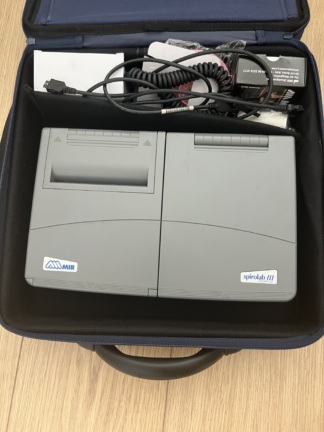
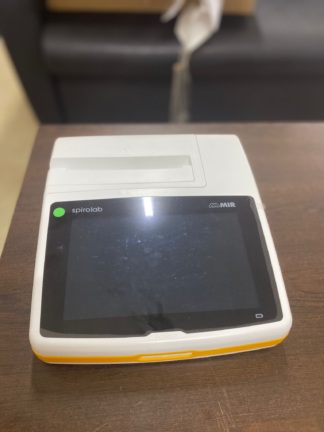
Based on a detailed examination of the images, the product has been identified as a professional spirometry (SFT) device. The device’s identity has been determined with 100% certainty thanks to the prominent logos and model names on the product. The inscription “spirolab III” and below it “COLOUR LCD” are clearly visible on the right side of the device’s lid. Furthermore, the “MIR” (Medical International Research) logo is present on the label of the sensor unit located in the device’s lower left compartment. In light of this data, the device’s brand is identified as MIR, and its model as SPIROLAB III. The device is a portable desktop spirometer with an integrated thermal printer and a color screen.
General Condition and Cosmetic Examination
The product appears to be in a clean and used condition overall. The gray plastic outer casing shows no noticeable deep scratches, breaks, cracks, or deformations due to heavy impact. The color of the plastic surfaces is consistent; no significant yellowing or color fading has been observed. The sensor slot cover on the left side of the device and the upper screen cover (clamshell design) appear mechanically sound. There is no visible damage to the hinge areas.
Areas of Use and Functionality
The device is a medical diagnostic instrument used to measure patients’ lung capacities and respiratory functions. As indicated by the blue function keys on the keyboard, it performs essential spirometry tests such as FVC (Forced Vital Capacity), VC (Vital Capacity), and MVV (Maximum Voluntary Ventilation). Additionally, the “SpO2” key on the keyboard suggests that the device may optionally support pulse oximetry (measurement of blood oxygen saturation).
Mechanical and Electronic Component Analysis
Screen: The LCD screen located on the device’s lid is in a closed position. Based on visual inspection of the screen surface, there are no cracks, breaks, or deep scratches that would suggest dead pixels.
Keyboard: It features a full QWERTY keyboard layout and a numeric keypad on the right side. The labels indicating functions such as patient data entry, file management (FILE), identification (ID), and printing (POST) on the keys are clear and legible. No fading due to excessive use is observed on the keys.
Printer: An integrated thermal printer unit is present in the upper left part of the device. The serrated structure of the paper output tray appears solid. The tray cover is closed and in place.
Accessories and Components
Turbine/Sensor Unit: In the front left drawer of the device, there is a handheld spirometer sensor (turbine holder) connected to the device with a coiled cable. The lens of the sensor’s optical reader part is discernible in the image.
Cables: No breaks or deformations have been detected in the coiled (spiral) cable between the sensor and the main unit, based on visible parts. A power adapter or charging cable is not present in the images.
Quantity Information: The images show 1 main unit and 1 sensor arm connected to this unit via a cable.
Label Information and Production Date
In the second image, the label on the sensor unit was examined in detail, and the following data was obtained:
- Brand: MIR (Medical International Research)
- Type/Model Code: Mir 021
- N. id (Serial No/ID): 18524
- Lotto (Batch/Lot No): 30/14
The “30/14” inscription on the label provides a strong clue regarding the production date or batch number. According to standard industrial coding, this inscription typically indicates the 30th week of 2014. Therefore, it is highly probable that the device’s production year is 2014.
Current Faults and Potential Risk Status
No physical breakage (such as compromised casing integrity, screen cracks, etc.) that would prevent the device from operating has been detected in the images. No warning lights or error messages indicating a “faulty” status are visible (due to the screen being off). However, the following points may require potential examination:
- As turbine sensors are delicate mechanical/optical parts, their calibration status cannot be confirmed from the visuals.
- It is not possible to determine externally whether the device is battery-powered or the condition of its battery.
- While the thermal printer’s cover appears robust, the internal condition of the printer mechanism (head, roller, etc.) is outside the scope of visual analysis.
In conclusion, based on its visual condition, the device is considered a well-preserved, physically intact, and clean medical device for its age.