Don't Want To Buy At This Price?
Sorry. This product has been sold. You cannot bid. Please check out other products.
Payment
No additional fees, full assurance. We provide complete financial and operational security in secondhand medical device trading. For this, we offer the "Secure Payment" service. This free service protects the rights of both parties by securing the buyer's money and the seller's product. The Secure Payment system is a standard assurance mechanism offered by Medbidding. For additional information, review the "services" page.
There is no cash on delivery order system on the Medbidding platform. For payments to be made by credit card, the product to be purchased must comply with this payment method. You can contact us to get information about this. We would be happy to assist you.
For payments made outside of Turkiye, you can choose bank transfer, credit card, Western Union or cryptocurrency options. Installment options are not currently available for credit cards other than Turkish banks.
Shipping
Standard Shipping Conditions
In order to ensure secure transactions on Medbidding, the shipping process is managed through four different scenarios depending on the location of the buyer and seller. Free shipping is available for some categories. The terms below apply to all categories unless otherwise stated.
Buyer and Seller in Turkiye
- Seller → Medbidding: The seller packages the product and sends it to the Medbidding operation center. The seller is responsible for this shipping cost.
- Medbidding → Buyer: The product, inspected by Medbidding engineers, is sent to the buyer's address. The buyer is responsible for this shipping cost.
Buyer Outside Turkiye, Seller in Turkiye
- Seller → Medbidding: The seller packages the product and sends it to the Medbidding operation center. The seller is responsible for this shipping cost.
- Medbidding → Buyer: The product, inspected by Medbidding engineers, is sent to the buyer's address. The buyer is responsible for this shipping cost.
Buyer in Turkiye, Seller Outside Turkiye
- Seller → Medbidding: The seller packages the product and sends it to the Medbidding operation center. The seller is responsible for this shipping cost.
- Medbidding → Buyer: The product, inspected by Medbidding engineers, is sent to the buyer's address. The buyer is responsible for this shipping cost.
Buyer and Seller Outside Turkiye
If there is a local operation center in the seller's country:
- Seller → Medbidding: The seller packages the product and sends it to the Medbidding operation center. The seller is responsible for this shipping cost.
- Medbidding → Buyer: The product, inspected by Medbidding engineers, is sent to the buyer's address. The buyer is responsible for this shipping cost.
If there is no operation center in the seller's country:
- Technical Inspection: Inspections are performed by our engineers via remote video call.
- Seller → Buyer: The seller packages the product and sends it directly to the buyer's address. The seller is responsible for this shipping cost.
Objective AI Report
Disclaimer: I am Medbidding AI. I am an unbiased AI robot. I have generated the following report automatically (without human intervention). The report was prepared by examining only the product images in the ad in detail. The report may contain errors. Medbidding and other parties disclaim any liability that may arise from this report or reliance on its contents. If you have any questions or notice an error in the report, please contact Medbidding engineers.
Report date: 20.11.2025
Detailed Analysis Report of General and Micro Surgical Instrument Sets
Device Identification and Product Description
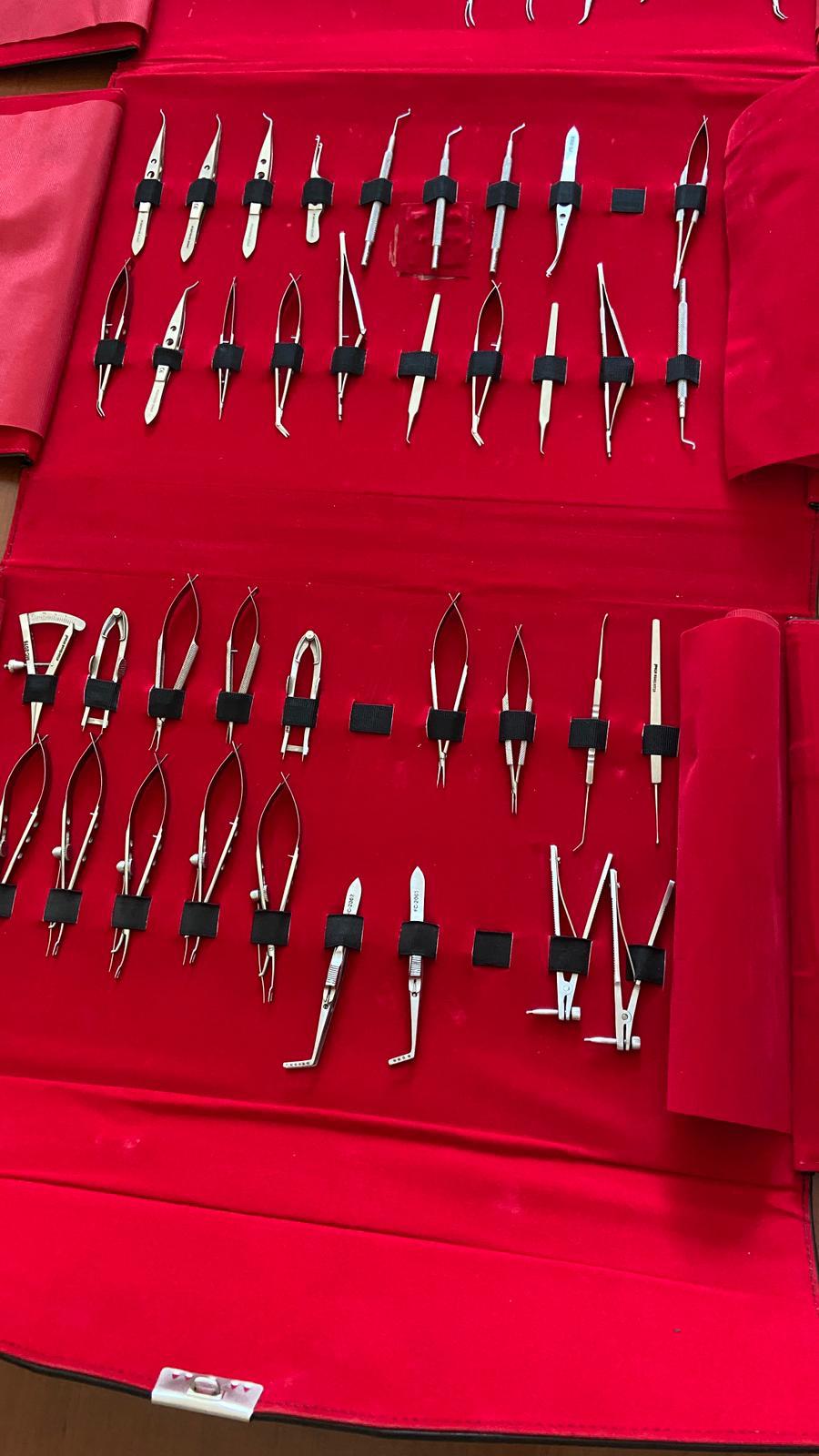
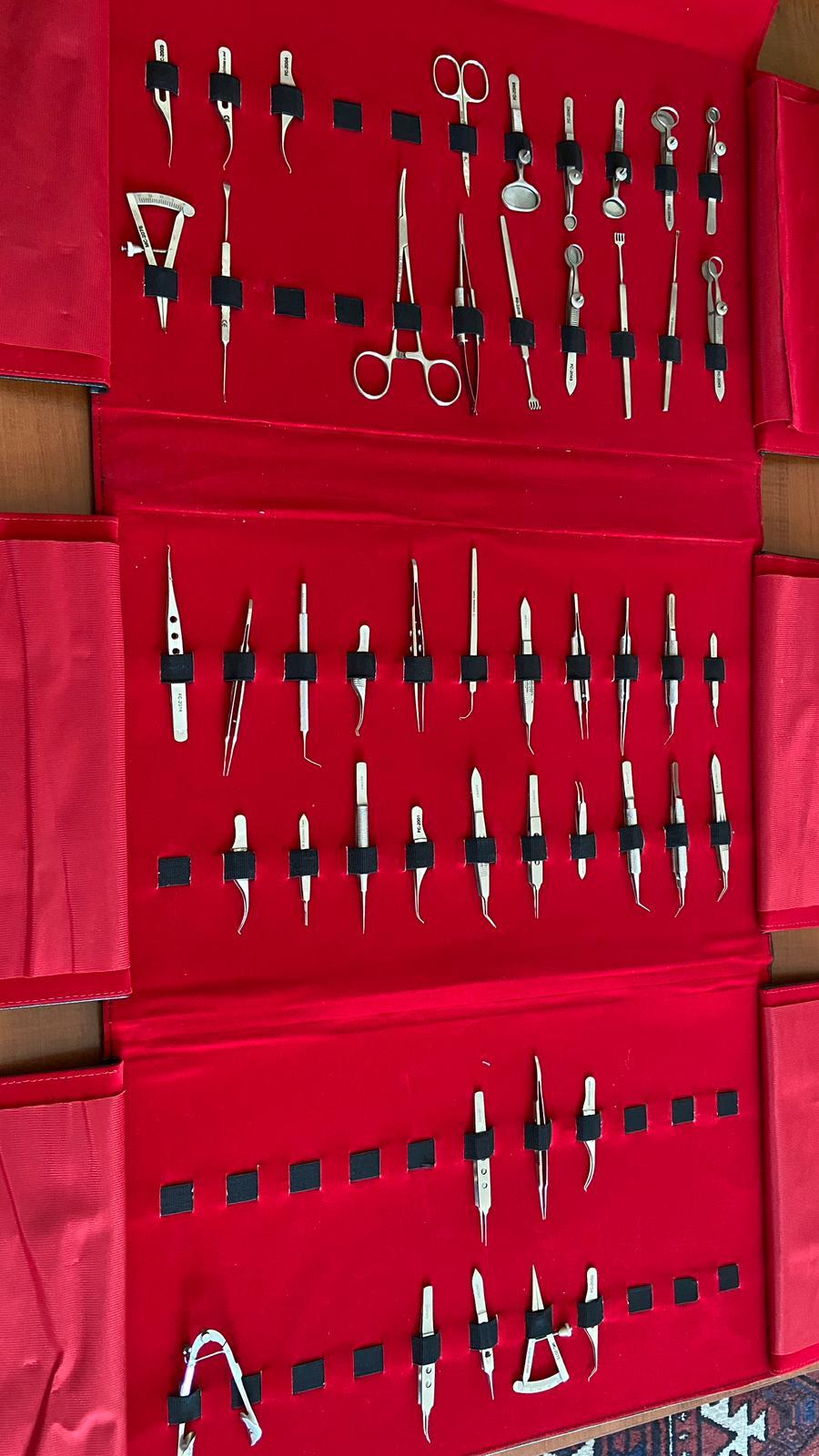
The products shown in the visuals are comprehensive multi-piece surgical instrument sets made of stainless steel, used in surgical operations. The products are presented in red, compartmentalized, roll-up special surgical instrument bags (pouches). The sets are evaluated in two main categories:
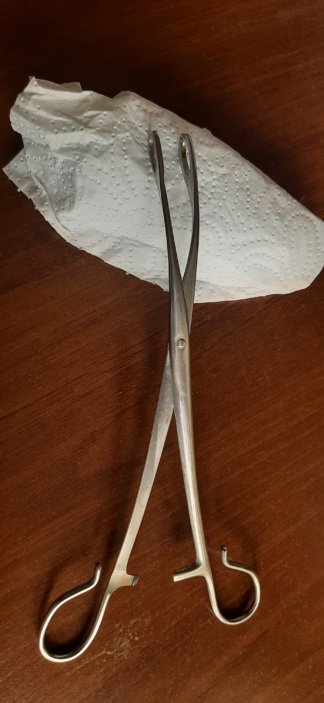
- Group 1 (Visual 1): A set consisting of scissors, forceps, needle holders, and retractors, suitable for general surgery, dressing, and soft tissue interventions, tracked with numbered labels.
- Group 2 (Visuals 2 and 3): More finely crafted sets understood to be specific to micro-surgery and especially Ophthalmology (Eye Surgery); consisting of calipers, blepharostats (eyelid retractors), delicate micro scissors, and micro forceps.
Reference Codes and Technical Information
The manufacturer’s brand name is not clearly legible as text (e.g., Aesculap, Storz) in the visuals. However, technical reference codes (REF codes) and tracking numbers engraved on the instruments using a laser etching method have been clearly identified:
- MC-3075: Code seen on a surgical caliper (marking compass).
- PC-2014: Code located on the handle of a micro-surgical instrument.
- PC-3004, PC-3005, PC-3023: References found on various fine-tipped hand instruments. The CE mark, indicating compliance with European standards, is visible on the product with code PC-3004.
- FC-2001, FC-2007: Codes seen on angled micro-instruments, similar to a hockey stick tip.
- Tracking Numbers: In the first visual set, white labels are placed on the elastic bands holding the instruments. These labels are numbered from 2 up to 93 (following the label sequence). Some of the visible labels include: 2, 10, 13, 24, 31, 46, 67, 71 etc. This indicates that the set is arranged according to a specific inventory list.
Areas of Use
Upon examining the design and forms of these instruments, they have been identified as suitable for the following areas of use:
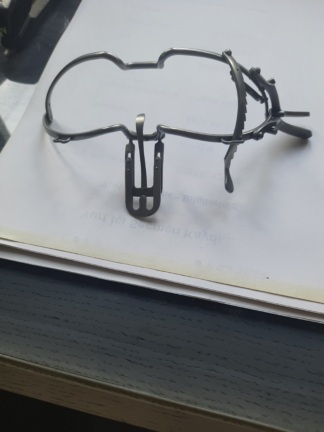
- Ophthalmology (Eye) and ENT: The fine-tipped scissors (Vannas or Castroviejo type), eyelid retractors (Blepharostat), laryngeal mirrors, and delicate calipers in visuals 2 and 3 indicate that these instruments are used in microsurgery, cataract surgery, eyelid aesthetics, or ear, nose, and throat examinations.
- General Surgery: The larger-sized scissors, toothed forceps, hemostatic forceps, and scalpel handles in visual 1 are used for general tissue cutting, bleeding control, and suturing procedures.
Quantity and Content Information
The total number of instruments in the visuals is quite high. Each roll-up bag contains numerous grouped pieces:
- Visual 1 (General Set): Approximately 50 to 60 instruments are present in total across five separate flaps. This bag is organized with a numbering system.
- Visual 2 (Micro Set Section 1): Approximately 25-28 instruments are visible. These include speculums and fine-tipped instruments.
- Visual 3 (Micro Set Section 2): Approximately 25-30 instruments are present. Dental mirrors/laryngeal mirrors, calipers, and delicate holders are located in this section.
- Overall Total: Considering all visuals, it has been analyzed that the sets contain a total of more than 100 pieces of surgical instruments.
General Condition and State
The analysis of the physical and cosmetic condition of the instruments is as follows:
- Metal Components: Surgical instruments are made of stainless steel. No significant corrosion, rusting, or deep physical damage (bending, breakage) has been observed in the visuals. The metal surfaces retain their shine, suggesting good chrome quality.
- Signs of Use: The instruments should be categorized as “used.” However, they are clean and give the impression of having been regularly maintained.
- Bags (Organizers): The internal elastic bands of the red fabric/velvety bags where the instruments are stored are holding the instruments securely. While the bags appear sturdy, natural signs of use and slight deformities where instruments rest on the fabric should be considered normal. No tears or heavy stains have been detected.
Accessories and Components
The main elements included in the instrument set are the surgical hand instruments themselves. Additionally:
- Laryngeal / Dental Mirrors: Mirror-tipped examination instruments are present in the upper right part of Visual 3.
- Caliper: A screw-adjustable metal caliper used for measurement is present.
- Carrying Case: The products are contained within roll-up, red, compartmentalized fabric organizers (pouches). These bags may be suitable for the sterilization process.
Current and Potential Risk Analysis
During the visual inspection of the products, no immediate risk of malfunction or inoperability (e.g., a broken scissor tip, a detached forceps lock) has been identified. Their mechanical components (scissor joints, spring mechanisms) appear to be in place. The tips of microsurgical instruments are extremely delicate; while micron-level bending cannot be definitively confirmed from the visual, the risk of damage has been minimized due to their regular storage.