Objective AI Report
Disclaimer: I am Medbidding AI. I am an unbiased AI robot. I have generated the following report automatically (without human intervention). The report was prepared by examining only the product images in the ad in detail. The report may contain errors. Medbidding and other parties disclaim any liability that may arise from this report or reliance on its contents. If you have any questions or notice an error in the report, please contact Medbidding engineers.
Report date: 02.02.2026
Wise 1946 Surgical Instrument Handle Analysis Report
Device Description and Identification
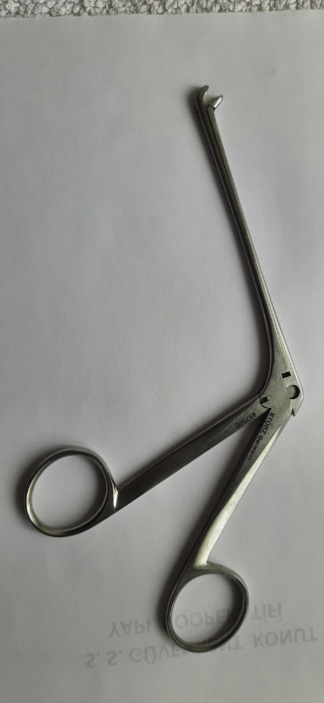
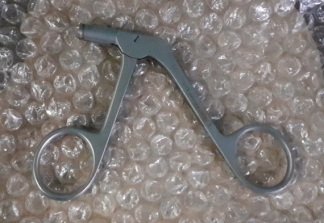
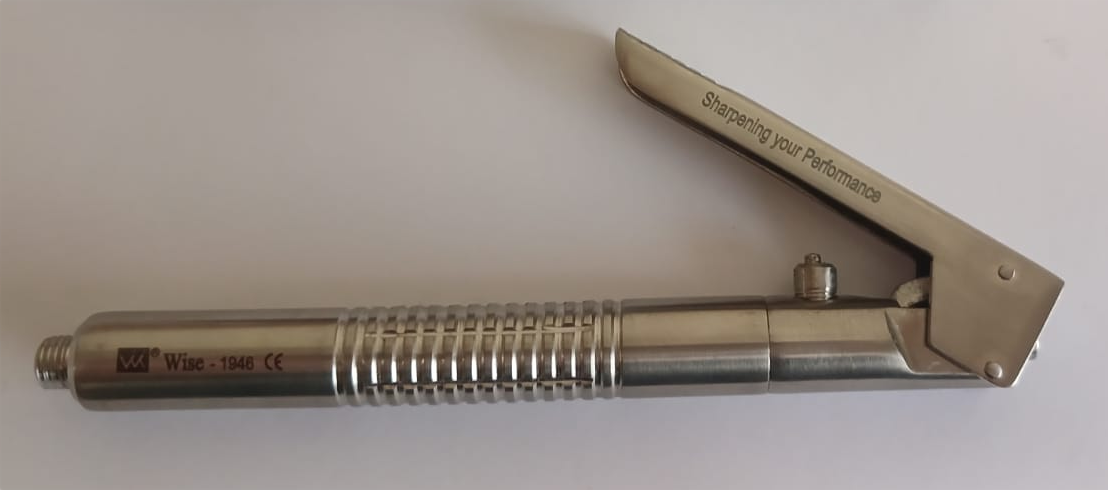
The analyzed image shows the body of a mechanical hand tool made of stainless steel, used in medical surgical operations. The product is a detachable surgical instrument handle, used in combination with different tips (such as punch or rongeur tips) that are attached to its end and not present in the image. Its trigger mechanism structure indicates that it is designed for cutting or detaching operations requiring force. The device is a single-piece hand unit.
Brand and Model Information
Upon examining the laser-engraved information on the product’s body, the brand and model can be clearly identified as follows:
- Brand: Wise
- Model / Reference Code: 1946
On the image, the brand name “Wise” is clearly visible, immediately next to the “1946” inscription, which represents the model or reference number. The logo (a ‘W’ within a square) and the font character on the product appear to conform to medical instrument manufacturer standards.
Originality and Quality Assessment
The marking on the product, the quality of the laser engraving, the surface smoothness, and the precise craftsmanship at the joints (especially the serrated texture on the grip and the trigger mechanism) indicate that the product is an original medical surgical instrument. Furthermore, the “CE” mark on the body confirms that the product is an original device compliant with European standards and intended for professional use.
Areas of Use
This product is not a functional device on its own, but rather the “power arm” or “handle” of a modular surgical set. Its use is anticipated in the following areas:
- General Surgery and Orthopedics: Used to perform bone biting and detaching (Laminectomy Punch or Rongeur) procedures, especially in bone or hard tissue surgery, via shafts attached to its end.
- Compatibility: The threaded (grooved) inlet at the left end of the device is designed for mounting surgical shafts and tips compatible with this handle. This design allows for ease of sterilization and multiple tip usage.
Overall Condition and Physical State
Upon examining the device’s external appearance, its overall condition is observed to be quite good. No loss of brightness, corrosion, rust, or dullness has been observed on the metal surface. The device can be classified as “lightly used” or “well-maintained”.
Physical and Mechanical Deformation Analysis
- Casing: No significant dents, deep scratches, or cracks are present on the stainless steel body. Surface integrity has been maintained.
- Mechanical Components: The trigger (lever) mechanism and connection pin appear sound. The stopper screw mechanism limiting the lever’s closure is in place.
- Screw Threads: The threads of the connecting screw at the end appear clean and intact; no signs of stripped or crushed threads have been found.
Label and Inscription Analysis
Instead of labels, the product features permanent inscriptions directly engraved onto the metal surface. The data read are as follows:
- Brand Logo: A stylized “W” inside a square on the left side.
- Brand and Code: The inscription “Wise – 1946”.
- Certification: The “CE” mark (Conformité Européenne).
- Slogan: The slogan “Sharpening your Performance” is located on the movable lever part.
Quantity and Accessories
Only 1 unit of the surgical instrument handle is present in the image. The product’s box, user manual, or operational shaft tips to be attached to its end are not present in the image.
Potential Risk Analysis
Based on visual inspections, no critical failure risk (rust, broken parts, missing spring pin, etc.) that would impede immediate use of the product has been observed. However, it should be noted that the product requires external tip parts to function and is inoperable on its own. As the stiffness or functionality of the product’s internal spring mechanism cannot be tested solely from the visual image, a physical test may be required for the smoothness of mechanical movement. Cosmetically, it is flawless.