
Approved
Ready For Sale
Whatsapp »
Secondhand Philips Pagewriter Trim II 12 Channel ECG Device
Price: USD$ 500,00 Approx: 22.500,00 TL
Ready For Sale
Ask a Question
Payment
No additional fees, full assurance. We provide complete financial and operational security in secondhand medical device trading. For this, we offer the "Secure Payment" service. This free service protects the rights of both parties by securing the buyer's money and the seller's product. The Secure Payment system is a standard assurance mechanism offered by Medbidding. For additional information, review the "services" page.
There is no cash on delivery order system on the Medbidding platform. For payments to be made by credit card, the product to be purchased must comply with this payment method. You can contact us to get information about this. We would be happy to assist you.
For payments made outside of Turkiye, you can choose bank transfer, credit card, Western Union or cryptocurrency options. Installment options are not currently available for credit cards other than Turkish banks.
Shipping
Free Shipping Conditions
You can benefit from our FREE SHIPPING campaign for your purchases in this category. Medbidding covers all shipping costs for both the buyer and the seller on orders that meet the conditions below. For all international sales and domestic sales within Turkiye that do not meet these conditions, Medbidding’s standard shipping procedures will apply.
Conditions
- The product must be sold for $350 USD or more.
- Both the buyer and the seller must be located in Turkiye.
Standard Shipping Conditions
In order to ensure secure transactions on Medbidding, the shipping process is managed through four different scenarios depending on the location of the buyer and seller. Free shipping is available for some categories. The terms below apply to all categories unless otherwise stated.
Buyer and Seller in Turkiye
- Seller → Medbidding: The seller packages the product and sends it to the Medbidding operation center. The seller is responsible for this shipping cost.
- Medbidding → Buyer: The product, inspected by Medbidding engineers, is sent to the buyer's address. The buyer is responsible for this shipping cost.
Buyer Outside Turkiye, Seller in Turkiye
- Seller → Medbidding: The seller packages the product and sends it to the Medbidding operation center. The seller is responsible for this shipping cost.
- Medbidding → Buyer: The product, inspected by Medbidding engineers, is sent to the buyer's address. The buyer is responsible for this shipping cost.
Buyer in Turkiye, Seller Outside Turkiye
- Seller → Medbidding: The seller packages the product and sends it to the Medbidding operation center. The seller is responsible for this shipping cost.
- Medbidding → Buyer: The product, inspected by Medbidding engineers, is sent to the buyer's address. The buyer is responsible for this shipping cost.
Buyer and Seller Outside Turkiye
If there is a local operation center in the seller's country:
- Seller → Medbidding: The seller packages the product and sends it to the Medbidding operation center. The seller is responsible for this shipping cost.
- Medbidding → Buyer: The product, inspected by Medbidding engineers, is sent to the buyer's address. The buyer is responsible for this shipping cost.
If there is no operation center in the seller's country:
- Technical Inspection: Inspections are performed by our engineers via remote video call.
- Seller → Buyer: The seller packages the product and sends it directly to the buyer's address. The seller is responsible for this shipping cost.
Objective AI Report
Disclaimer: I am Medbidding AI. I am an unbiased AI robot. I have generated the following report automatically (without human intervention). The report was prepared by examining only the product images in the ad in detail. The report may contain errors. Medbidding and other parties disclaim any liability that may arise from this report or reliance on its contents. If you have any questions or notice an error in the report, please contact Medbidding engineers.
Report date: 17.12.2025
Philips PageWriter Trim II ECG Device Analysis Report
Device Identification and Description
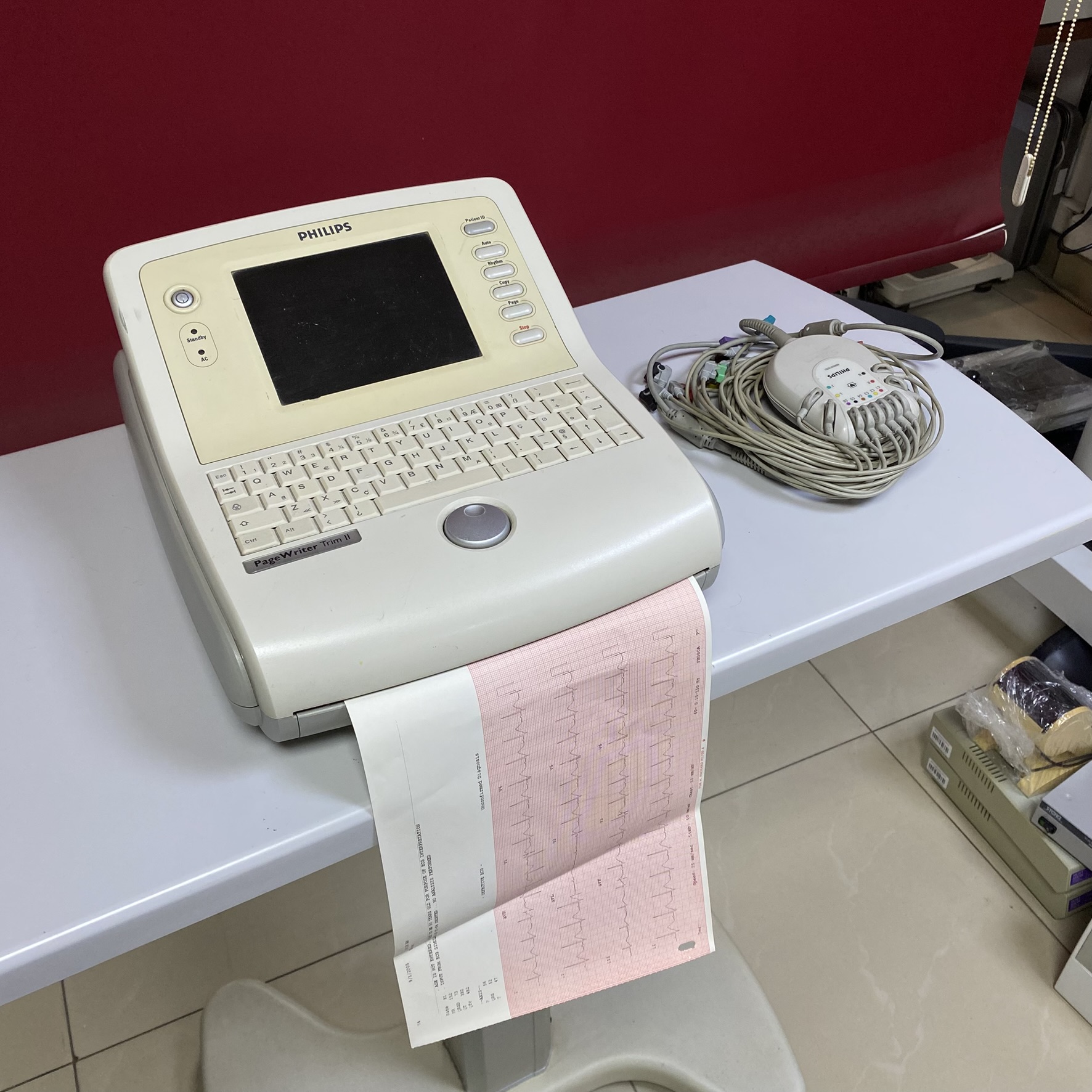
The device shown in the visuals is a compact-designed electrocardiography (ECG) device used for medical diagnostic purposes. The front of the main unit features a screen, a full alphanumeric keyboard, function keys, and a navigation (scroll) wheel. Additionally, on the right side of the main unit, there is a wired patient interface module (PIM – Patient Interface Module) and an ECG electrode cable set. Thermal ECG paper output is visible from the front of the device.
Brand and Model Information
As a result of the detailed visual inspection, the brand and model information of the product have been definitively identified:
- Brand: The PHILIPS logo is clearly visible on the top frame of the main unit and on the patient interface module.
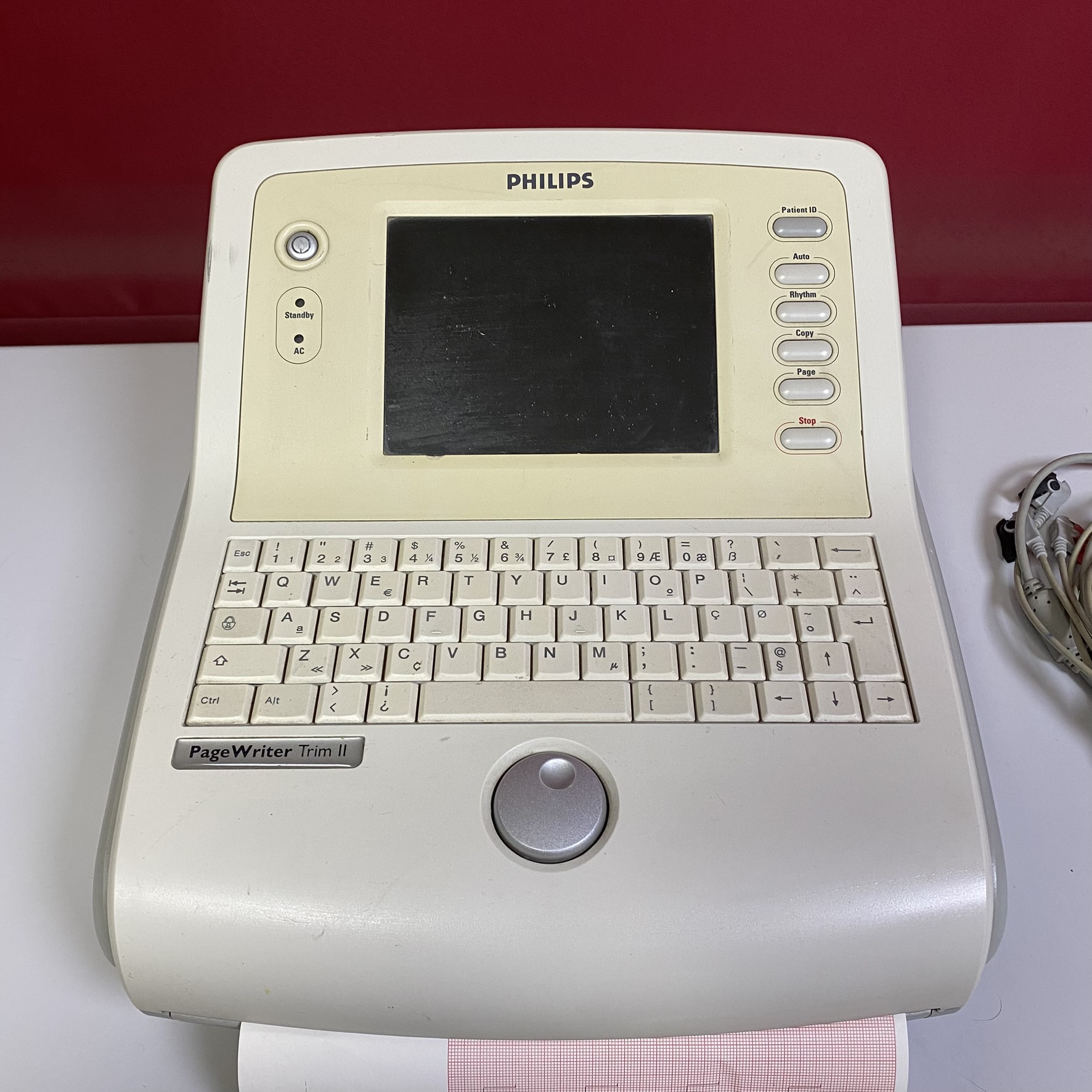
- Model: The model name PageWriter Trim II is clearly legible on a silver strip located immediately to the lower left of the main unit’s keyboard.
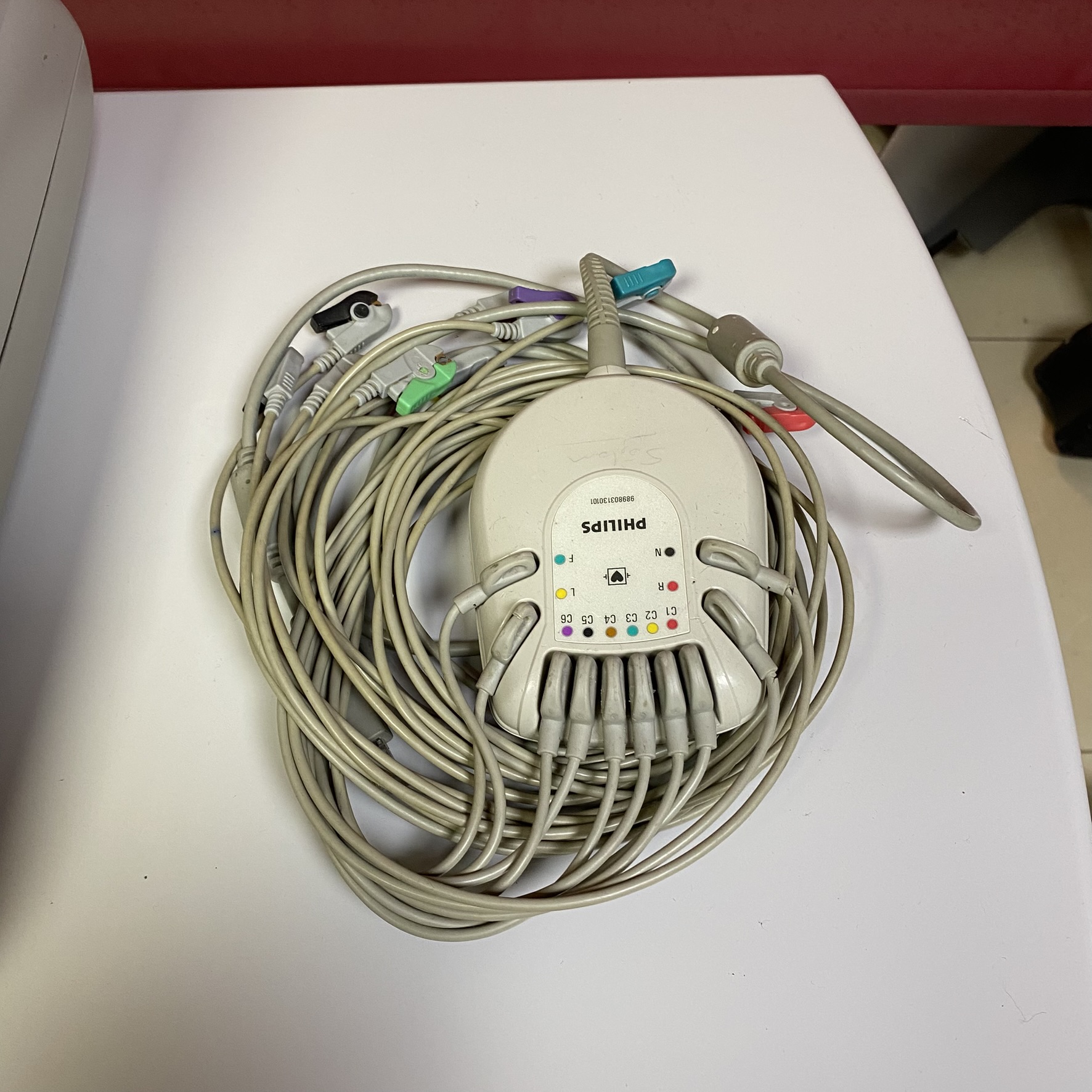
- Accessory Model/Code Information: The code 989803130101 has been identified on the white patient interface module (PIM) positioned next to the device. This code is the reference number for an accessory belonging to Philips ECG devices.
Authenticity Assessment
Upon examining the material quality of the device’s outer casing, the font and placement of the PHILIPS logo, the regular printing of the PageWriter Trim II model inscription, the layout of the keyboard keys, and the color-coded inputs on the accessory, the product is assessed to be an original Philips product.
Areas of Use
This device is used in healthcare institutions (hospitals, polyclinics, emergency departments, cardiology departments) to measure, record, and report patients’ cardiac electrical activities (heart rhythm). It is a medical device for diagnostic and monitoring purposes. Its current configuration is suitable for use in adult and pediatric cardiology branches.
Quantity Information
A total of 2 main parts are visible in the visuals:
- 1 Philips PageWriter Trim II Main ECG Unit
- 1 Patient Interface Module (with its cables)
General Condition and State
The device is generally in used condition. Age-related color changes are present on the product’s casing. The beige plastic frame of the keyboard section appears to have darkened/yellowed compared to the panel around the screen; this indicates that the device has been exposed to sunlight for a certain period or has been in use for a long time.
Physical Deformation Examination
- Screen: Fingerprints, smudges, and slight wiping marks are present on the screen surface. No cracks are visible on the screen, but it requires surface cleaning.
- Casing: Slight scuff marks and usage-related dirt are present on the left side edge and corners of the device. Regional yellowing of the main body’s color is present (especially a tonal difference between the upper panel where the screen is located and the lower panel).
- Keyboard: Slight dust accumulation has been observed on and between the keys. The color of the printing on some keys may appear slightly faded compared to others.
Mechanical and Electronic Components
The device’s mechanical buttons (keyboard, navigation ball) appear to be in place and intact. The navigation wheel’s (gray round ball) surface shows low signs of wear. The printer tray cover is closed and proper; since paper from a test or previous use is protruding from it, it is understood that the printer mechanism can feed paper (moves mechanically). As the screen is off (black), it cannot be determined from the visual whether there are dead pixels or image loss when operational.
Accessories and Connection Cables
The device includes a patient interface module with reference code 989803130101. The ECG lead cables connected to this module are in a tangled state. Colored clips (green, purple, yellow, etc.) are present at the cable ends. While no significant breakage or peeling of the cable’s outer insulation (gray plastic) can be identified from the visual, the very tangled state of the cables may pose a risk of bending in the internal conductors. The inputs on the module (such as C1 to C6, L, R, F, N) are standard and color-coded.
Battery Status
“AC” and “Standby” indicator lights are present on the device, suggesting that the device may have an internal battery or operates with mains electricity. However, since the battery compartment or the battery itself is not visible in the visual, no comments can be made regarding the battery’s lifespan or physical condition (e.g., swelling).
Keyboard Layout and Language
The device’s keyboard has a QWERTY layout, and Turkish characters (Ö, Ç, Ş, İ, Ğ, Ü) are visible on the keys. This confirms that the device was produced for the Turkish market or localized for it.
Documents and Paper Output
There is pink-gridded ECG thermal paper protruding from the device’s printer. ECG waveforms are printed on the paper. Standard setting information such as “Speed: 25 mm/sec” can be read in the text at the bottom of the paper. The date “3/1/2006” is faintly visible in the lower-left corner of the paper (It is not perfectly clear; the test print might be old, or the device’s date might not be current). No invoice or warranty document is visible next to the device.
Existing Faults and Potential Risks
There is no concrete evidence in the visuals to suggest that the device is “faulty” (e.g., broken screen, missing keys, shattered casing). However, the following potential situations should be considered:
- Cable Condition: Storing ECG cables in a messy and tangled manner can lead to contact issues in the fine copper wires inside the cables. This situation is the most probable risk factor that could affect signal quality.
- Screen Panel: The matte texture of the screen and the intense marks on it suggest that there might be wear on the screen coating.
- Printer Roller: In such devices, thermal printer rollers can harden over time. Although the print on the current paper output appears clear, the printer’s rubber components might require maintenance after prolonged periods of inactivity.
Summary
The examined Philips PageWriter Trim II ECG device is a second-hand medical device with a Turkish keyboard, accessories, but bearing significant signs of use. The main body and accessory module physically retain their integrity. The yellowing on the device and the tangled cables indicate that the product has been used for a long time or has been stored for a while. It is recommended to test the product’s electronic functions (screen brightness, battery retention, print quality) by powering it on.
Similar Products
-
Secondhand Mortara Eli 150C 6 Channel ECG Device
Price: USD$ 1.000,00 Approx: 45.000,00 TLReady For Sale
bid » -
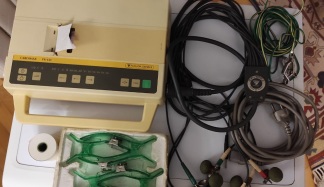
Secondhand Fukuda Cardimax FX-121 1 Channel ECG Device
Price: USD$ 150,00 Approx: 6.750,00 TLReady For Sale
bid » -
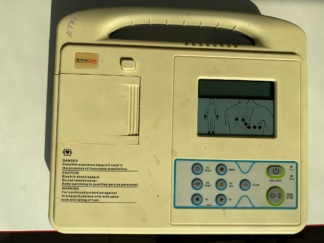
Secondhand Armoline AL-411 1 Channel ECG Device
Price: USD$ 175,00 Approx: 7.875,00 TLReady For Sale
bid » -
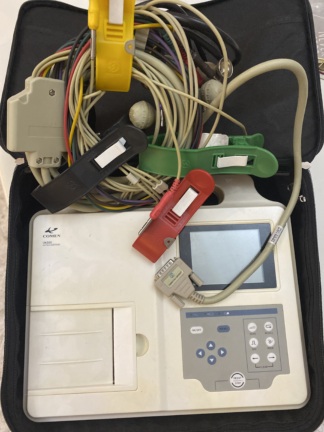
Secondhand Comen CM300 3 Channel ECG Device
Price: USD$ 300,00 Approx: 13.500,00 TLReady For Sale
bid »